


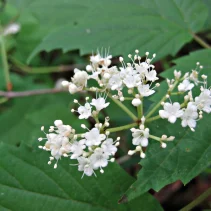
This handsome ornamental shade tree produces showy, fragrant blossoms that attract birds, bees, and butterflies. The pale yellow blossoms which emerge in early summer are a magnet for bees. In full bloom, the trees attract so many bees that a buzzing sound can be heard from their canopies! A gourmet honey is collected from bees who have gathered nectar from this tree’s flowers. The flowers are also commonly utilized in herbal medicine. A rarity among temperate trees, American Basswood has edible leaves. They can be steamed in a manner similar to spinach, or added to soups and stews. They impart a mucilaginous texture to dishes and can be used for thickening. Their fall color is pale green to pale yellow. In winter, trees may be tapped in a fashion similar to Maple trees, to make syrup with their sap. The wood is light and easily worked, used to make furniture, shipping crates, boxes, and veneer.
Sun to part shade. Low maintenance, Grows to 80′, rarely 100′. Tolerates some drought and dryness. Tolerates clay soil. Easily grown in moist well-drained soils in full sun to part shade. Prefers moist, fertile, well-drained loams. Trees naturally occur in dry upland, as well as low moist woods.
A few interesting facts about this species: The common name “Basswood” references the inner bark, or “bast” of the tree, which is used to make rope and mats. The genus name “Tilia” refers to the Latin name for these trees. Interestingly, in southern Sweden, these trees are known as “Linn.” This word is the origin of the name “Linnaeus,” who developed the system of taxonomy we still use today!
Be the first to review “Tilia americana – American Basswood, American Linden”
Related products


Drought Tolerant


Attracts Wildlife


Attracts Wildlife

Reviews
There are no reviews yet.