


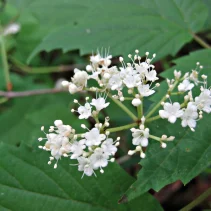
General Information: This stout shrub forms a beautiful blanket of foliage and flowers throughout the year. During the spring, the prominently-veined leaves emerge providing a pleasant mounded appearance. From June through August, the white to pinkish flowers emerge, lending a “snowy” appearance to the shrubs. These flowers are highly attractive to pollinators, so much so that audible buzzing can sometimes be heard some distance from the plants. After flowering, the minute brown seed capsules begin to ripen. The seeds of New Jersey Tea are encased in a pod which splits open with such force that they are launched several feet from the parent plant. In autumn the bushes recede into the background, developing yellowish or tan leaves. During winter, the bushes may also stand out against the snow, with their bare branches sporting hues of green to a slight red. New Jersey Tea is a host plant for several Butterfly and Moth species. The seeds are eaten by ground-dwelling birds, and the twigs and foliage are often consumed by herbivores. This plant is reported to have been used as a medicine extensively by Indigenous Peoples within the plant’s native range.
Edible Qualities: The leaves of New Jersey Tea are harvested when the plant is in full bloom. They are then dried for use as a Tea (Camellia sinensis) substitute. The tea is said to have an invigorating effect, despite there not being any caffeine present in the plant.
Cultivation Details: These plants are self-fertile. Only one is required to produce seeds. Due to an extensive taproot, these plants do not tolerate transplant and should be planted in a permanent location. After a year of establishment, plants can be hard pruned to encourage a bushy appearance. Like many other members of the family Rhamnaceae, these plants form symbiotic partnerships with soil microbes which fix nitrogen. New Jersey Tea therefore improves soil fertility in the immediate vicinity of the plant’s roots, which can also be utilized by surrounding plants. Consider pairing New Jersey Tea with other selections from our “Attracts Wildlife” or “Drought Tolerant” categories. Growers should be cautioned that Deer tend to browse this plant, therefore they should be planted away from areas where Deer are problematic. A perfect choice as a sub-shrub layer to compliment larger plants, in native plant gardens, in pollinator gardens, in medicinal plant gardens, and as a foundation or border planting. While typically slow to spread by seed, and rarely spreading by root sucker, these plants can eventually be grown out beautifully in mass plantings, especially as a form of erosion control.
Growing Requirements: Plant in full sun to partial shade. Plants in partial shade may not bloom as profusely as those in full sun. Prefers medium-moist to dry soils. Prefers sandy soil. Tolerant of rocky or gravelly soils. Does not tolerate very moist or clay soils. Suitable for very acidic, neutral, and mildly alkaline soils.
Fun Facts: The common name of this plant, New Jersey Tea, derives from the use of this plant as a substitute for imported teas during the American Revolution.
Be the first to review “Ceanothus americanus – New Jersey Tea; Redroot”
Related products


Attracts Wildlife


Attracts Wildlife


Attracts Wildlife




Attracts Wildlife


Reviews
There are no reviews yet.