


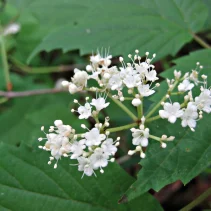
General Information: A lovely native ground cover with deeply lobed leaves and dainty white flowers. The way the flowers dance and bob in the breeze gives this plant the common name “Windflower.” The leaf buds and flowers are a welcome sign of spring. The leaves arise in April, and the flowers emerge en masse in May and persist for roughly one month. Sporadic flowering sometimes occurs throughout the summer. After flowering, the plants form dense mats of greenery which do a fantastic job at keeping out weeds. Their golf ball-like seed pods are quite as interesting as their flowers! In fall, their greenery tends to die back slightly earlier than the surrounding foliage, making room for any late-season companion plants to really stand out. For anyone in the Northeastern or Central US struggling to keep weeds at bay, Windflower is certainly a good native candidate to create a solid groundcover. This plant is used medicinally by Indigenous Peoples. Curiously, in old times, the root of this plant was reportedly eaten by singers to clear their throats before a performance.
Cultivation Details: These plants perform best when they are in full sun. In gardens with limited space, consider planting them in partial to nearly full shade to limit their spread, as they will make themselves at home in any sunny spot! Windflower makes an excellent companion to tall perennial wildflowers. Consider pairing with Echinacea species, Goldenrods (Solidago species), Asters (Symphyotrichum species), Milkweeds (Asclepias species), and others. Suitable planting locations include along borders, edges, fences, under trees and shrubs, along walkways and foundations, in seaside gardens, and in native plant gardens. These plants readily inhibit the growth of some species, namely legumes. These plants are Deer and Rabbit resistant. The Windflower on our farm also tolerates light foot traffic and will regenerate quickly after being cut to the ground.
Growing Requirements: Plant in full sun to nearly full shade. Plants in full and partial sun tend to spread very quickly. Shade limits the spread of this plant. Prefers moist, well-drained soils. Tolerates drier conditions once fully established. Suitable for mildly acidic, neutral, and mildly alkaline soils.
Be the first to review “Anemone canadensis – Windflower; Canada Anemone”
Related products


Evergreens

Attracts Wildlife

Edible Fruit


Attracts Wildlife

Best Sellers


Drought Tolerant
Reviews
There are no reviews yet.